
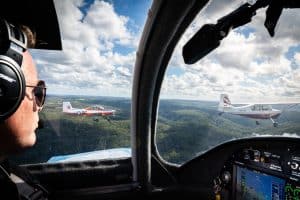
The Formation Flying Endorsement allows you to safely operate an aircraft in close proximity to another aircraft as part of a coordinated group. Formation flying requires a high level of precision, discipline, and situational awareness, making it one of the most advanced and rewarding forms of visual flying.
This endorsement develops your ability to maintain accurate positioning, manage workload, and operate as part of a team while maintaining strict safety standards.
Formation flying is classified as a flight activity endorsement under CASA Part 61, meaning you must complete specific training and be assessed as competent before conducting formation operations.
It involves flying in close proximity to one or more aircraft while maintaining precise positioning and coordination. Unlike standard flying, formation operations rely on visual references, communication, and disciplined procedures to ensure safety and consistency.
The course is designed to teach you the theory and practical skills required to plan, brief, and safely conduct a formation flight. You’ll learn how to operate as part of a coordinated team, with a strong emphasis on communication, planning, and situational awareness.
Training includes formation procedures such as joining and rejoining, maintaining position, and safely separating from the formation. You’ll also develop an understanding of how to manage workload and maintain accurate positioning throughout all phases of flight.
You’ll be introduced to standard formation positions and learn how to maintain them accurately while the formation manoeuvres as a single unit. This includes operating as a wingman and maintaining position relative to the lead aircraft.
Training also covers key procedures such as formation take-offs, joins, breakaways, and rejoining the formation. These skills are essential to ensure safe and predictable operation when flying in close proximity to other aircraft.
To undertake the Formation Flying Endorsement, you must hold at least a Recreational Pilot Licence (RPL) or higher, along with appropriate recency and a strong standard of general aircraft handling.
Formation flying requires precise aircraft control and situational awareness, so a solid foundation of flying skills is essential before commencing training.
Training duration and pricing are indicative only and are based on the average hours required to achieve competency. As this is a competency-based course, the actual time and cost will vary depending on individual progress and the aircraft selected for training. Different aircraft have different operating costs, so final pricing will depend on your chosen aircraft and any additional training required.
| Component | Approximate Cost |
|---|---|
| Formation Flying Endorsement | Contact Us |
| Typical duration: 7–9 hours (competency-based) Pricing varies depending on the aircraft selected for training. Contact us for a tailored quote based on your preferred aircraft. | |
Formation flying demands a level of accuracy and discipline that significantly improves overall flying ability. It sharpens your control inputs, enhances your awareness of relative positioning, and develops strong communication and decision-making skills.
It also provides a unique and highly rewarding flying experience, allowing you to operate as part of a coordinated team rather than as an individual aircraft.
The Formation Flying Endorsement is a natural progression for pilots looking to advance their skills and experience more demanding flight operations. It builds precision, awareness, and confidence while opening the door to more advanced flying opportunities.
Our instructors will guide you through each stage of the training, ensuring you develop the skills required to safely and confidently operate in formation.
Develop the precision, coordination, and confidence required to fly safely in formation. Speak with our team today to plan your Formation Flying Endorsement and experience one of the most rewarding forms of flight training.
Training is competency-based, but most pilots complete the endorsement over several flights depending on experience and progression.
You must hold at least an RPL or higher, along with appropriate recency and a strong standard of aircraft handling.
You’ll learn formation procedures including joining, maintaining position, breakaways, and rejoining, as well as communication and coordination techniques required for safe formation flight.
Yes — when conducted with proper training and procedures, formation flying is safe. The course focuses heavily on discipline, communication, and maintaining safe separation at all times.
Let us know what you were trying to find and we’ll point you in the right direction.