
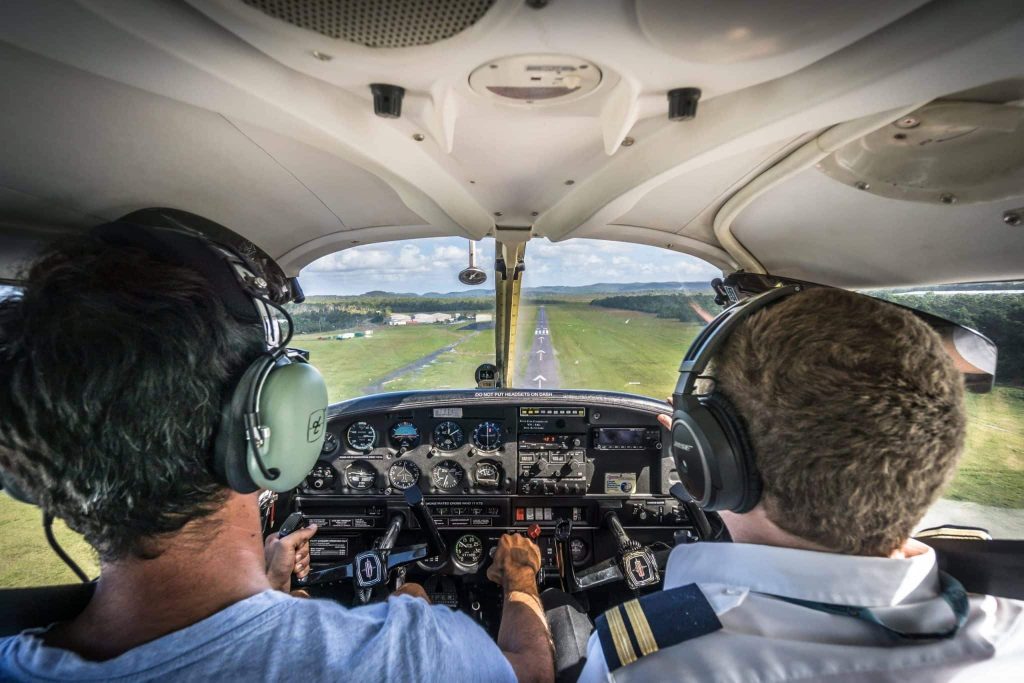
The Recreational Pilot Licence (RPL) allows you to fly within 25 nautical miles of your departure aerodrome during daylight hours in good weather conditions. Many pilots use the RPL for recreational flying with family and friends, while others continue their training toward higher licences such as the Private Pilot Licence (PPL) or Commercial Pilot Licence (CPL).
The Recreational Pilot Licence (RPL) is the first step toward becoming a pilot in Australia. At Central Coast Aero Club in Warnervale, our RPL training provides students with a structured pathway to learn to fly in a supportive and practical training environment. The Central Coast Aero Club is easily accessed from the Central Coast, Newcastle and Sydney.
Training for the RPL combines practical flight instruction with aviation theory, giving you the skills and knowledge required to safely operate an aircraft. You’ll learn aircraft control, circuit operations, navigation basics, aviation safety, and how to make sound decisions as a pilot.
At Central Coast Aero Club, our experienced instructors guide you through each stage of the training in a structured and supportive environment.
Learning to fly is a structured process that gradually builds your skills and confidence in the aircraft. Your training progresses through several stages, beginning with the fundamentals of aircraft control and finishing with the skills required to safely operate an aircraft as pilot in command. At Central Coast Aero Club, your instructor will guide you through each stage at a pace that suits your progress and experience.
This is the first stage of your flight training and focuses on the fundamental skills required to safely control the aircraft. During this phase you will learn how the aircraft responds to your control inputs and how to operate safely in the aerodrome environment.
Typically, your first solo flight is after 12-15 hours of flight instruction however this may vary based on pilot competency.
During this phase you will apply for a licence number (ARN), a medical, provide general English proficiency and complete a short theory exam.
Training typically includes:
As your confidence and ability improve, you will progress toward your first solo flight, an important milestone where you fly the aircraft on your own for the first time.
Once you have demonstrated safe aircraft handling and completed your first solo flight, your training expands beyond the circuit area. In this stage you begin developing independence as a pilot and learning to manage the aircraft without direct instructor input.
Training in this phase includes:
These flights help build confidence and prepare you for operating safely within the privileges of the Recreational Pilot Licence. During this phase you will also complete a short theory exam.
The final stage of training focuses on refining and consolidating your flying skills and preparing you for the RPL flight test. By this stage you will be operating the aircraft with increasing independence while demonstrating safe decision-making and good airmanship.
Training during this stage includes:
Once your instructor is satisfied that you meet the required standard, you will complete the RPL(A) flight test with a flight examiner. This test involves both ground theory and practical flight components.
During this phase you will sit the CASA RPL(A) theory exam, a radio exam, complete an Aviation English Language Assessment and apply for an aviation security clearance.
To obtain a Recreational Pilot Licence (RPL) in Australia you must meet several basic requirements set by the Civil Aviation Safety Authority (CASA). These ensure pilots have the knowledge, skills, and medical fitness required to operate an aircraft safely.
Although the minimum hours required is 25, most students complete their Recreational Pilot Licence training in around 35-40 flight hours, depending on individual progress and how regularly lessons are taken.
Training is conducted one-on-one with an instructor, allowing you to build skills and confidence at your own pace.
As mentioned above, most pilots require more training than the legal minimum. We quote our costs based on the average hours to give you a more realistic price estimate. The typical total cost to complete your RPL is $17,525, and may increase if additional training is required.
This is a guide only – flight training is competency-based, and additional training may be required depending on individual progress.
You do not need to pay this upfront; you simply pay for each flight and/or theory session at the conclusion of each lesson.
| Component | Cost |
|---|---|
| Flying | $14,130 |
| Based on average hours of completion. Hours may be lower or higher depending on competency level. Costs are based on flying in a Cessna C150 which is a weight limited aircraft, if you are over 90kgs you will need to complete the training in a 4 seater aircraft with a slight price increase (additional $75/hour), contact us for details (note, completing the RPL in a 4 seater aircraft will reduce the Private Pilot Licence (PPL) cost) | |
| Ancillary Items | $3,395 |
| This covers the cost of textbooks, ground briefings to assist you with your theory study for the exams, combined cost of various exams required to complete the syllabus, medical, aviation security clearance (ASIC). This also includes the Flight Test Fee for the RPL. | |
| Typical Total Cost | $17,525 |
Choosing the right flight school is one of the most important decisions in your aviation journey. At Central Coast Aero Club (CCAC), we provide a training environment that combines experience, location, and efficiency to give students the best possible start in aviation.
Central Coast Aero Club is based at Warnervale Airport on the NSW Central Coast, making it easily accessible for students travelling from Sydney, the Central Coast, and Newcastle.
Located just minutes from the freeway, the airport is only 40 minutes from the Hornsby interchange and around 30 minutes from the Wallsend interchange, making it practical for students commuting from across the region.
This central location allows many students to complete training while continuing with work, study, or other commitments.
Our instructors bring a wealth of knowledge and real-world aviation experience to every lesson. Collectively, CCAC instructors have over 30,000 hours of flight instruction experience, ensuring students receive professional guidance throughout their training.
Many of our graduates have gone on to achieve their aviation goals, including:
One of the biggest advantages of learning to fly at Warnervale Airport is the efficiency of the training environment.
Because the airport is located within our training area, it takes only a few minutes after take-off before you are practising the skills required for your lesson.
Warnervale is also an uncontrolled airport, which means students typically avoid long taxi queues and departure delays that can occur at larger controlled airports. This allows you to spend more of your lesson actually flying, gaining valuable experience and making faster progress in your training.
Central Coast Aero Club has a long history of supporting pilots at every stage of their aviation journey. From your first lesson through to advanced licences, you will be part of a welcoming aviation community that encourages learning, safety, and a genuine passion for flying.
Once you obtain your Recreational Pilot Licence (RPL), you can act as pilot in command of an aircraft and carry passengers on private flights. This gives you the freedom to share the experience of flying with friends and family and enjoy aviation on your own terms.
Many pilots use their RPL to explore new destinations, take scenic flights, and continue developing their flying skills. It’s also a great way to stay active in aviation while enjoying the challenge and satisfaction that comes with learning to fly.
For those who want to go further, the RPL is also the first step toward more advanced training. Many pilots choose to continue on to the Private Pilot Licence (PPL), which expands your flying privileges and allows longer cross-country flights.
Whether your goal is recreational flying, personal travel, or progressing through higher pilot licences, the Recreational Pilot Licence is the gateway to your journey as a pilot.
With an RPL, you can add endorsements to your RPL. At the Central Coast Aero Club we offer the following endorsements you can add to your RPL to expand your flying capabilities:
Qualify to operate more advanced aircraft, including:
Develop specialised skills with endorsements such as:
Whether you are aiming to fly recreationally or pursue a professional aviation career, Central Coast Aero Club offers the experience, location, and training environment to help you succeed.
Contact us today to learn more about flight training at Warnervale Airport and how you can begin your journey into aviation.
The best way to start is with a Trial Instructional Flight, where you sit in the pilot’s seat with an instructor and experience flying first-hand. From there, most students progress into a Recreational Pilot Licence (RPL), followed by a Private Pilot Licence (PPL) and potentially a Commercial Pilot Licence (CPL).
No prior experience is required. Many students begin with no aviation background at all and learn progressively through structured training with an instructor, building skills and confidence step by step.
The time varies depending on your goals and how often you train. Some students fly regularly and progress quickly, while others train around work or family commitments. Flight training is flexible and designed to suit your schedule. The average time it takes to complete the RPL is around 35-40 hours of flight. We typically find that if you do one lesson a week, it will take a year to complete the RPL training, this allows some weeks for weather cancellations or personal leave. The more regularly you do lessons the shorter that timeframe can become.
There is no maximum or minimum limit to how often you fly. If you live further away and want to maximise your time at the airport you can book multiple lessons in on one day. If you want to spread the training out to assist with budgeting, you can do one lesson a month. We will work with you to fit training in with your budget and schedule.
All flight training begins with the Recreational Pilot Licence (RPL), which forms the foundation of your flying skills. Once completed, you can progress to the Private Pilot Licence (PPL) and then the Commercial Pilot Licence (CPL) if you wish to pursue a professional aviation career.
You can absolutely learn to fly for fun. Many pilots train purely for recreational flying, enjoying weekend flights, coastal trips and the freedom of aviation without pursuing a career.
Warnervale Airport offers a relaxed, non-towered training environment with minimal delays, allowing students to spend more time flying and less time waiting. The training area is only minutes away, making each lesson more efficient and productive.
The cost depends on the licence you are working toward, how often you fly, and how quickly you progress. Training is typically paid as you go, allowing you to manage your budget and pace your learning accordingly.
After gaining your licence, you can continue flying recreationally, take friends and family on flights, or continue into advanced training such as instrument ratings or multi-engine flying.
Flight training is challenging but highly rewarding. With structured lessons and guidance from experienced instructors, students gradually develop the skills, knowledge and confidence needed to fly safely and independently.
Yes. Many students complete their training part-time. Lessons can be scheduled around work and personal commitments, allowing you to progress at a pace that suits your lifestyle.
Legally there is no minimum age requirement to start flight training. You need to be 15 years of age to complete your first solo flight and need to be 16 years of age to sit the RPL flight test. Typically, the Central Coast Aero Club requires you to be at least 14 years of age before starting the structured syllabus of flying for the RPL. If you are less than 14 years of age, we recommend doing trial flights to build your experience before than starting structured lessons at 14 years of age.
There is no maximum age either, as long as you have enough mobility to get in and out of the aircraft and can move all the controls through there applicable ranges. You would also need to be able to pass the required CASA medical.
Let us know what you were trying to find and we’ll point you in the right direction.