
If you hold an overseas pilot licence, you can convert it to an Australian licence and start flying locally – whether you’re visiting short-term or planning to stay.
This page shows you exactly what transfers, what doesn’t, and the fastest way to get flying in Australia.
In Australia, there isn’t a single conversion process – instead, there are several pathways depending on your situation. Choosing the right one from the start will save you time, cost, and unnecessary steps.
This guide explains how conversion works under Civil Aviation Safety Authority (CASA), what transfers across, and what you’ll need to complete before flying in Australia.
This is a guidance page only, we recommend you always check CASA’s website for the most up-to-date information.
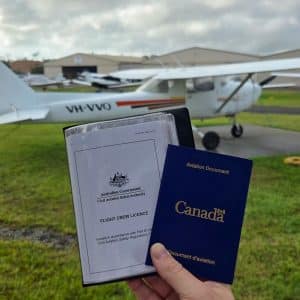
Some options are quick and temporary, while others lead to a permanent Australian licence issued by the Civil Aviation Safety Authority (CASA).
If you already hold an overseas pilot licence, much of your experience can be recognised in Australia – but not everything carries across directly.
What transfers:
What doesn’t:
Your ICAO licence (PPL, CPL or ATPL) will convert over. Operational ratings and endorsements vary depending on the country of origin.
A Certificate of Validation allows you to fly an Australian-registered aircraft for a specific purpose for up to 12 months. It’s designed for short-term visitors who want to fly without committing to a full licence conversion.
To get started, you’ll need to apply for an Aviation Reference Number (ARN) through CASA and complete the required security clearance, which usually takes 4–6 weeks. (Note, an AVID security clearance has limitations but can be applied for while outside of Australia. An ASIC security clearance has less limitations, but can usually only be done in Australia)
You’ll also need to meet English language proficiency requirements (ICAO Level 4, 5 or 6), and in some cases, CASA may ask for a flight test depending on your licence and ratings.
Your overseas medical can be used as long as it matches the level of flying you intend to do. CASA will typically verify your licence with the issuing authority, and you may need to authorise this process.
Once issued, the CoV is valid for up to 12 months, but it is not renewable — if you return to Australia later, you’ll need to apply again.
If you’re planning to stay in Australia or return regularly, a permanent conversion is the right path. This results in a full Australian licence issued by CASA. CASA will recognise any licence issued by an ICAO state.
The process starts by applying for an ARN and submitting CASA Form 61-4A, where you provide details of your overseas licence and flight experience. CASA will then verify your licence with the issuing authority, which can take a few weeks. You may also have to authorise the release of the information from your home countries aviation body.
You’ll need an Australian aviation medical and an ASIC security clearance before your licence can be issued. Depending on your licence, CASA may also require an English language assessment.
What happens next depends on your licence level; typically:
Once all requirements are complete, your Australian licence will be issued. From that point, it remains valid indefinitely, provided your medical and flight review stay current.
For New Zealand licence holders who hold a professional qualification (CPL, ATPL, Instrument Rating and/or Instructor Rating), the Trans-Tasman Mutual Recognition Act provides a more direct pathway.
You’ll need to apply for licence verification through the New Zealand authority and submit the required CASA form. An Australian medical and ASIC are still required, and once issued, your licence will be converted to the equivalent Australian qualification.
Operational ratings such as instrument or instructor ratings are recognised, but they must be validated with an Australian proficiency check before use.
If you only hold a New Zealand private licence, you will need to undertake one of the other steps above.
If you’re only in Australia for a short time, the easiest option is to fly with an instructor without converting your licence.
This avoids all CASA paperwork and approvals, allowing you to get in the air immediately. However, under Australian regulations, you won’t be able to carry passengers yourself. Any flight involving passengers must be conducted as a scenic or charter flight, with the instructor acting as pilot in command.
As you can see, the process varies depending on your licence and circumstances – but it doesn’t need to be complicated when you follow the right pathway from the start.
Don’t waste weeks trying to interpret CASA requirements.
Send us your licence details and we’ll:
Get started today!
In most cases, you cannot fly an Australian-registered aircraft on your overseas licence alone. You’ll need either a Certificate of Validation (CoV) or convert your licence through the Civil Aviation Safety Authority (CASA), depending on how long you plan to stay.
The simplest option is a Certificate of Validation (CoV), which allows you to fly for up to 12 months.
If you’re only visiting briefly, flying with an instructor is often even easier as it avoids the CASA approval process entirely.
Yes – flight hours are generally recognised regardless of where you trained or flew.
However, you’ll still need to meet Australian requirements for licence validity, including flight reviews and air law.
It depends on your licence level.
CASA will advise exactly what is required after reviewing your application.
Timeframes vary depending on your pathway:
The biggest delays are usually licence verification and ASIC processing, always apply early to remove any time constraints.
You can start parts of the process before arriving, including:
However, flight reviews and tests must be completed in Australia.
Yes – under the Trans-Tasman Mutual Recognition Act, New Zealand professional licences (CPL & ATPL) can be converted more directly.
You’ll still need an Australian medical and security clearance, and some ratings require a proficiency check.
Yes — for most CASA approvals (including CoV and licence issue), you’ll need an aviation security clearance such as an ASIC or AVID.
This process usually takes 4–6 weeks.
Let us know what you were trying to find and we’ll point you in the right direction.