CCAC HISTORICAL ARCHIVES

Hangar and Office Approved for Wyong Airstrip

July 18, 1973

Source Citation:

Central Coast Newspapers, 18 July 1973, “Hangar and Office for Wyong Airstrip”, p. 1 (continued on p. 2).

Exceptional Historical Significance
One of the earliest and most important infrastructure milestones in the history of Warnervale Airport. This article documents Wyong Shire Council's approval for permanent facilities—including a hangar, administration office and amenities building—moving the site beyond a simple landing strip towards an operational aerodrome. It also demonstrates that, even in 1973, proponents were planning for passenger services and charter operations, making it a key primary source documenting the airport's earliest physical development.

This article records one of the earliest physical developments associated with the future Warnervale Airport. While previous council decisions had approved the concept of a light aircraft strip, this report documents approval for permanent infrastructure, including a hangar, administration office and amenities building for Wyong Air Services.

The article illustrates that, in 1973, the project was still dependent on approvals from the Department of Civil Aviation and the State Planning Authority, highlighting the regulatory process involved in establishing a new aerodrome. It also reflects Council’s long-term vision for the site, with discussion extending beyond recreational flying to the possibility of passenger, freight and charter operations.

As one of the earliest records of permanent airport facilities being approved, this article marks an important milestone in the transformation of the Pollock Avenue site into what would eventually become Warnervale Airport.
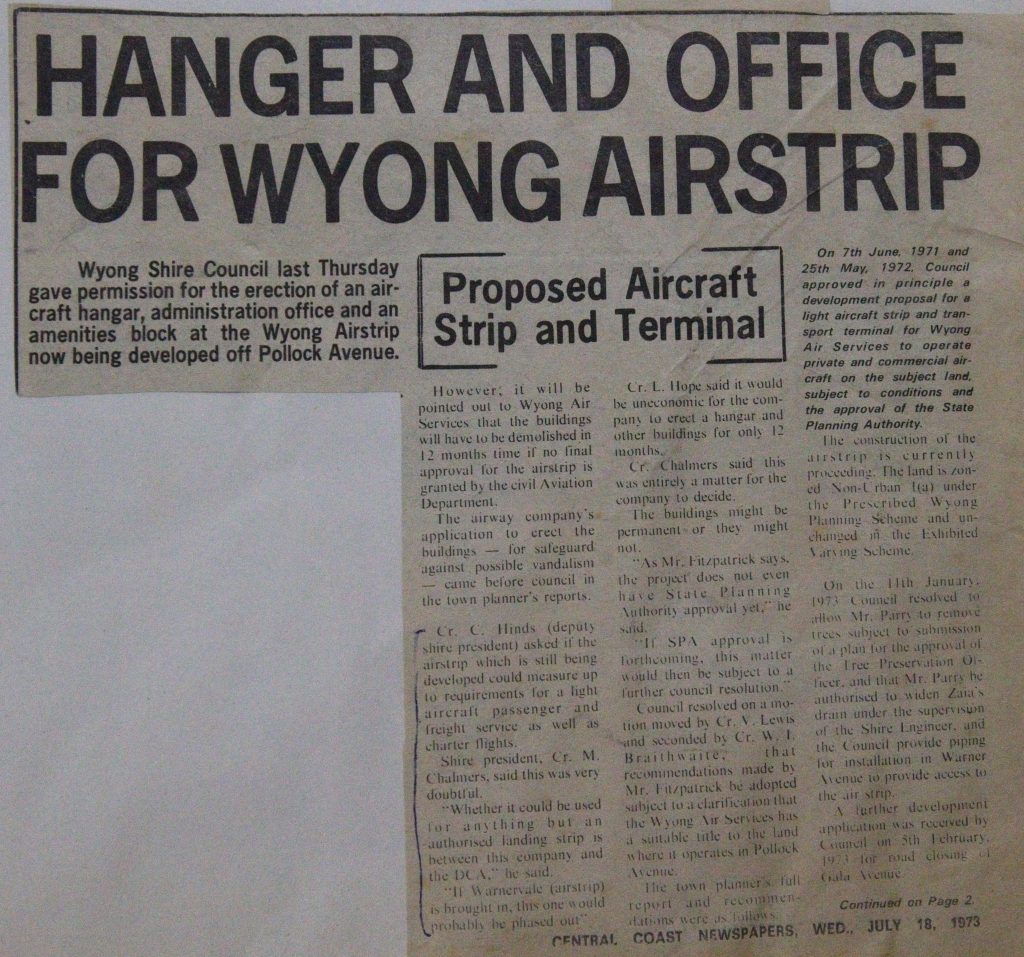
HANGER AND OFFICE FOR WYONG AIRSTRIP Proposed Aircraft Strip and Terminal Wyong Shire Council last Thursday gave permission for the erection of an aircraft hangar, administration office and an amenities block at the Wyong Airstrip now being developed off Pollock Avenue. However, it will be pointed out to Wyong Air Services that the buildings will have to be demolished in 12 months’ time if no final approval for the airstrip is granted by the Civil Aviation Department. The airway company’s application to erect the buildings—for safeguard against possible vandalism—came before council in the town planner’s reports. Cr. C. Hinds (Deputy Shire President) asked if the airstrip, which is still being developed, could measure up to requirements for a light aircraft passenger and freight service as well as charter flights. Shire President, Cr. M. Chalmers, said this was very doubtful. “Whether it could be used for anything but an authorised landing strip is between this company and the DCA,” he said. “If Warnervale (airstrip) is brought in, this one would probably be phased out.” Cr. L. Hope said it would be uneconomic for the company to erect a hangar and other buildings for only 12 months. Cr. Chalmers said this was entirely a matter for the company to decide. The buildings might be permanent or they might not. “As Mr. Fitzpatrick says, the project does not even have State Planning Authority approval yet,” he said. “If SPA approval is forthcoming, this matter would then be subject to a further council resolution.” Council resolved on a motion moved by Cr. V. Lewis and seconded by Cr. W. J. Braithwaite that recommendations made by Mr. Fitzpatrick be adopted subject to a clarification that Wyong Air Services has a suitable title to the land where it operates in Pollock Avenue. The town planner’s full report and recommendations were as follows: On 7th June, 1971 and 25th May, 1972, Council approved in principle a development proposal for a light aircraft strip and transport terminal for Wyong Air Services to operate private and commercial aircraft on the subject land, subject to conditions and the approval of the State Planning Authority. The construction of the airstrip is currently proceeding. The land is zoned Non-Urban (1a) under the Prescribed Wyong Planning Scheme and unchanged in the Exhibited Warring Scheme. On the 11th January, 1973 Council resolved to allow Mr. Parry to remove trees subject to submission of a plan for the approval of the Tree Preservation Officer, and that Mr. Parry be authorised to widen [Axis] drain under the supervision of the Shire Engineer, and the Council provide piping for installation in Warren Avenue to provide access to the air strip. A further development application was received by Council on 5th February, 1973 for road closing of Julia Avenue. Continued on Page 2.
Facebook
Twitter
Email

Report a Broken Link

Let us know what you were trying to find and we’ll point you in the right direction.